Monday, September 11, 2017

Off-Broadway Theater Review: Curvy Widow

Nancy Opel. Photo: T. Charles Erickson

Curvy Widow
Music and Lyrics by Drew Brody
Book By Bobby Goldman
Choreography by Marcos Santana
Directed by Peter Flynn
West Side Theatre

By Lauren Yarger
Say the words Nancy Opel and I smile. The extraordinarily voiced and comedic genius actress has graced the stage in many shows including Beautiful, Honeymoon in Vegas, Memphis, Gypsy, Fiddler on the Roof, Urinetown, Triumph of Love, Anything Goes, Sunday in the Park with George and Evita among others and I never have not loved watching her work.

She is starring Off-Broadway in Curvy Widow, the true story of Bobby Goldman, a construction company owner who suddenly finds herself alone when her famous writer husband, Jim -- that's James Goldman, author of Follies, "The Lion in Winter," A Family Affair), played by Ken Land, dies. Mostly unmemorable Music (except for "It's Not a Match") with witty and Lyrics by Drew Brody drive Bobby's book about her experiences at trying to date again. Getting a special shout out for storytelling, here, however, is Scenic Designer Rob Bissinger, who expertly changes locations (two apartments) and moods with a few props. A pair of slippers next to the bed speaks volumes. Costume Designer Brian C. Hemesath sets up quick changes, having Opel switch only tops to slip between situations in the fast-paced hour and 45 minutes.

The ensemble cast, which appears crowded on the small Westside Theatre stage as they play Bobby's friends, her psychiatrist and dates -- disastrous and otherwise -- are put through their paces by Director Peter Flynn and Choreographer Marcos Santana. Besides Land, they include Andrea Bianchi, Aisha de Haas, Elizabeth Ward Land, Alan Muraoka (standing out) and Chris Shyer. 

We follow post 50-year-old Bobby as she navigates the new and strange world of online dating. Curvy Widow is her "handle" on the sites. She is at once intrigued and repulsed by the fact that hundreds of men who have never seen her (she refuses to post a photo) and who know her only by her alias, might be willing to have sex with her. We experience her first date, her experimentation with a sex site and the discovery of one match that might be different from the others. All of this takes place while she is haunted by guilt over wondering whether Jim would be OK with what she is doing -- well, maybe she's really haunted more by his ghost.

Opel throws herself into the role and sings some lovely mote combinations that made me very happy. The show is somewhat uneven, however, despite previous out-of-town runs. And it's a little hard to relate to Bobby, especially when she decides to make married men a non-committal specialty. (You might have a chance to hear from the real Booby in person, however, as she occasionally does post-show talks and answers questions from the audience).

More Information:
Curvy Widow plays at The Westside Theatre, Upstairs, 407 West 43rd St., NYC Performances are Monday at 8 pm, Tuesday at 7 pm, Wednesday at 2 and 8 pm, Friday at 8 pm, Saturday at 2 and 8 pm, Sunday at 3 pm. Tickets are $79-$99: 212-239-6200www.CurvyWidow.com.

Additional credits:
Lighting Design by Matthew Richards; Sound Design by Ryan Rumery and M. Florian Staab; Musical Direction by Andrew Sotomayor; Orchestrations, Arrangements and Music Supervision by Wayne Barker

FAMILY-FRIENDLY FACTORS:
-- God's name taken in vain
-- Language
-- Suggestive situations

Broadway Theater Review: Prince of Broadway


Prince of Broadway
New songs, Arrangements, Orchestration and Music Supervision by Jason Robert Brown
Book by David Thompson
Direction and Choreography by Susan Stroman with direction by Harold Prince
Manhattan Theatre Club

By Lauren Yarger
Hal Prince and I would have been great theater buddies. We apparently love the same musicals. 

In Prince of Broadway, theatergoers get to enjoy almost 40 tunes celebrating the career of 21-time, Tony-winner Producer/Director Harold Prince as arranged and orchestrated by Jason Robert Brown (The Bridges of Madison County; The Last Five Years) and Choreographed and Directed by a legend in her own right, Susan Stroman (The Producers, The Scottsboro Boys) with some direction by Prince himself. With almost every number, I found myself saying, "Oh, I love this song," or " I love that show" and finally, I just thought, "Thank you, Hal Prince."

The problem is that if you aren't me, or at least an aficionado of musical theater from the past 60 years, you probably won't know a lot of the songs, or what show they are from, or why those particular songs have been selected. And even if you recognize the songs and shows (or are able to follow along in the Playbill in the dark) David Thompson's uneven book, still might still leave you scratching your head.

The very capable ensemble features Tony Award winner Chuck Cooper (Caroline, or Change; Choir Boy), Drama Desk Award winner Janet Dacal (In The Heights, Good Vibrations), Bryonha Marie Parham (After Midnight, Porgy and Bess), Emily Skinner (Side Show, The Full Monty), Brandon Uranowitz (Falsettos, An American in Paris), Kaley Ann Voorhees (The Phantom of the Opera, Candide), Michael Xavier (Sunset Boulevard, Into The Woods), Tony Yazbeck (On the Town, Gypsy), and Tony-Award-winner Karen Ziemba (Contact, Curtains). There just is no rhyme or reason to why they are performing the songs which recreate moments from the Prince theater repertoire (in many cases faithfully reproduced visually by Scenic and Projection Designer Beowulf Boritt.) 

All of them speak in the voice of Prince. Some of the shows are identified; some background is given and logos from some of the shows are depicted through projections. (A critic colleague seemed to think they all had been, and perhaps they weren't visible from my seat, but I didn’t see them all.) At any rate, I jotted notes about how I thought many audience members wouldn't be able to identify numbers like "Tonight at Eight" and "Will He Like Me?" from 1963's She Loves Me or "Dressing Them Up," from 1993's The Kiss of the Spiderwoman.

There are some other selections from Follies, Parade and Merrily We Roll Along that might evade identification by the more casual theatergoer too.  "You've Got Possibilities" from the hardly known 1966 musical "It's a Bird, It's a Plane. . . It's Superman" at least is properly identified and explained.

There's no reason why "Heart" from Damn Yankees or "If I Were a Rich Man" were singled out to represent those shows (the latter causing some negative comments from colleagues – particularly Jewish reviewers – about the casting of Cooper at Tevye,) when other shows got two or three songs. 

There are some wonderful moments: Parham is sensational as Queenie in "Can't Help Lovin' Dat Man" from Showboat and Ziemba is a saucy, meaty Mrs. Lovett in the medley of tunes from Sweeney Todd. I immediately wanted to see them both in revivals of those shows. Skinner delivers the most moving "Send in the Clowns" from A Little Night Music I ever have heard -- and I saw Glynis Johns in the original production so that is saying something. Goosebumps. This number alone is probably worth the ticket price to this show.

FAMILY-FRIENDLY FACTORS:

-         No specific notes

Tuesday, August 29, 2017

Off-Broadway Theater Review: If Only -- TOP PICK

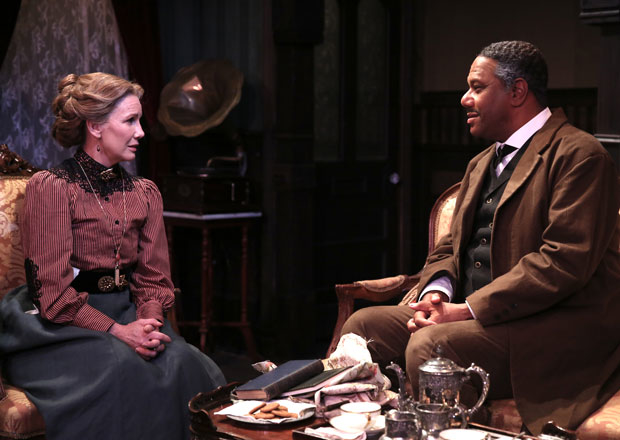
Melissa Gilbert and Mark Kenneth Smaltz. Photo: Carol Rosegg


If Only
By Thomas Klingenstein
Directed by Christopher McElroen
Cherry Lane Theatre
Through Sept. 17

By Lauren Yarger
If only all plays could be so lyrical, eloquent and timely. . . 

Thomas Klingenstein's poignant new play If Only, getting a limited Off-Broadway run at the Cherry Lane Theatre through Sept. 17, imagines what race relations in our country might be like had President Abraham Lincoln not been assassinated.

Set 36 years after John Wilkes Booth fired the fatal shot at Ford's Theater, the play follows the reunion of two people who called President Abraham Lincoln “friend.” Ann Astorcott ("Little House on the Prairie"'s Melissa Gilbert), is a stifled New York society housewife who recently took in a mute orphan named Sophie (Korinne Tetlow) to do something useful with her life. Being a housewife is rather unfulfilling for the woman who met Lincoln and served at a hospital during the war. That is where she met Samuel Johnson (Mark Kenneth Smaltz), a runaway slave who went on to serve as Lincoln's valet. All these years later, Samuel has been in contact and is coming for a visit.

Inattentive husband, Henry (Richmond Hoxie), agrees to allow Ann to have a visitor -- just another whim he gives in to as proof of his love for the wife he doesn't quite understand. He doesn't get her obsession with Lincoln, whom he accuses her of giving deity status thanks to a bust she keeps on her desk.

"Not a god," she replies, "But as perfect as God made a man."

He shrugs off the visit as unimportant and leaves to attend a meeting. What he doesn't realize is that Lincoln represented a hope of how things might have been not only for racial relations in America, but for possibilities of marriage between blacks and whites -- that is to say, between Samuel and Ann.

During their visit, it becomes clear that this couple shared a great love and that both still care deeply, though Ann is in denial and pretends not to remember some of their cherished moments together. Their conversation is engaging, intellectual and stimulating about everything from how to re-arrange the apartment (beautifully appointed in Victorian style by Scenic Designer William Boles) to the complexities of Lincoln's plan to make -- or not make, as the debate ensues -- blacks and whites equal. 

Their discourse is a sharp contrast to the conversation between Ann and Henry, where the couple talks in distracted fashion without ever communicating. Ann's primary means of expression are a story-journal she keeps (which alludes to her experiences with Lincoln and Samuel) and which she reads aloud to Sophie. In subtle direction, we see that Samuel, in offering a pillow to Ann, is much more attentive to her real needs than her husband, who is more obsessed with the inanimate portrait of his perfect image of his wife that hangs in the parlor.

Klingenstein's dialogue is eloquent and lyrical. Combined with subtle lighting (Design by Becca Jeffords) and muted colors and tones in the set and costumes (Design by Kimberly Manning), Director Christopher McElroen transports us back in time while spotlighting issues about race that, in many ways, don't seem all that different in 2017. It's a skillful journey. Klingenstein, a New York-based playwright whose work has been presented at The Lark where If Only was developed, has another play from the era, Douglass, which premiered last year in Chicago.

Gilbert delivers layers for Ann, taking her from the wife who doesn't want to upset Henry in the slightest to the intelligent woman hiding underneath the norm demanded by society. This woman isn't afraid to speak her mind and expound ideas that would upset a great many in the country. Smaltz portrays Samuel as elegant, caring, patient and tolerant, as he understands that change can't come all at once.

"Memory cannot reshape the soul," and "anger has no logic all its own," he observes in some of the thought-provoking statements that pepper the conversation. Samuel has a way of retelling history (he's a teacher of it) that makes it real -- much like the gift of this playwright has in bringing the past to the present in just 85 minutes without intermission..

If Only runs only through Sept. 17 at the Cherry Lane Theater, 38 Commerce St.

FAMILY-FRIENDLY FACTORS:
-- No content notes

Sunday, August 6, 2017

Off-BroadwayTheater Review: Pipelne TOP PICK

Karen Pittman (foreground) and Namir Smallwood. Photo: Jeremy Daniel
Pipeline
By Dominique Morisseau
Directed by Lileana Blain-Cruz
Lincoln Center
Through Aug. 27

By Lauren Yarger
What's It All About?
Dominique Morriseau's touching study of a mother trying to give her son a better life in the midst of a system stacked against him. Nya Joseph (an intense Karen Pittman) teaches a a public, inner-city high school while sending her son, Omari (Namir Smallwood) to private boarding school. When African-American Omari is provoked during a discussion of Richard Wright's "Native Son", attacks his white teacher and is threatened with expulsion form the school, Nya's world begins to fall apart and she makes some sacrifices. She reaches out to Omari's less-than-polished girlfriend, Jasmine (Heather Velazquez) and the boy's estranged father, Xavier (Morocco Omari), for help. The one who really needs help, however, is Nya who can't take the stress of seeing her son's chances being taken away as the "pipeline" which steers underprivileged kids from inner-city schools to prison seems to be winning. Her friends, school security guard Dun (Jamie Lincoln Smith) and teacher colleague, Laurie (Tasha Lawrence) try to help, but there may not be a solution here.

What Are the Highlights?
Excellent direction by Lileana Blain-Cruz and a riveting performance by Pittman propel the taut storytelling and lyrical prose of Morriseau's work (which packs a punch in 90 minutes with no intermission).  Lawrence (If I Forget, The Whale, Good People) is a pistol -- no a machine gun -- as the fed-up educator who expresses scathing opinions about her charges that teachers everywhere probably wish they could say.

Morriseau (Skeleton Crew) distinguishes herself here as a playwright to watch. Her development of character is expert. We learn so much about Omari and Jasmine, for example, just in a metaphor where he compares her to a metamorphic rock.

The show attracted a younger, much more diverse audience for the matinee I attended and the young people, many of whom appeared to be on school trips, were engaged throughout without the usual clowning around or phone use during the show that can be typical of these kind of audiences.

Matt Saunders' set is so realistic, right down to the Linoleum, that it looks as though it were salvaged from an old school. A few props are pushed on to change locations.

What Are the Lowlights?
A lack of resolution -- but perhaps that is a statement about society's problems in general.

More Information:
Pipeline educates through Aug. 27 at Lincoln Center's Mitzi E. Newhouse Theater, 150 West 65th St. lincolncenter.org

Additional credits:
Costumes by Montana Levi Blanco, Lighting by Yi Zhao, Sound by Justin Ellington, Projections by Hannah Wasileski

FAMILY-FRIENDLY FACTORS:
-- God's name taken in vain
-- Derogatory racial word used
-- Language

Off-Broadway Theater Review: A Midsummer Night's Dream

Richard Poe, Annaleigh Ashford, and Alex Hernandez. Photo: Joan Marcus.

A Midsummer Night's Dream
By William Shakespeare 
Directed by Lear deBessonet
Choreography by Chase Brock
Public Theater
Through Aug. 13

By Lauren Yarger
What's It All About? 
Seriously, if you don't know the story, I refer you to a volume of classic works by William Shakespeare or Spark notes. After seeing this particular play countless times (some theater I cover presents it at least once a season), I will beg off describing the silly plots about Gods playing tricks on each other in Athens, unsuspecting mortals getting caught in the crossfire and of amateur thespians set on performing at a royal wedding. Note: in case you doubt that I have seen this play enough times to be tired of it, the first Helena I ever saw was Diana Rigg in 1968

What Are the Highlights?
This version, directed by Lear deBessonet, founder of The Public Theater’s Public Works program, offers a couple of pleasant treats: Annaleigh Ashford (as Helena) and Kristine Neilsen as Puck. These are two of the theaters finest comedic actresses and they don't disappoint here. Ashford runs away with the show, playing Helena with a physical and vocal humor that has us laughing out loud all the way through the three hour run time. She's razor sharp on all counts. Look for award nominations here.  Nielsen is a sophisticated, yet discombobulated Puck, sharing "private" moments and expressions of confusion with the audience. It's a comedy more subtle than Ashford's and they each have a place in deBessonaet's direction.

Also turning in notable performances, in a very strong ensemble cast, are Danny Burstein as Nick Bottom, Richard Poe as Oberon and Phylicia Rashad as Titania.

David Rockwell masterfully brings Central Park onto the stage:

Kyle Beltran, Kristine Nielsen, and Shalita Grant. Photo: Joan Marcus

What Are the Lowlights?
I didn't care for the heavy, jazzy original music by Justin Levine (who also supervises and orchestrates) sung by Fairy Singer Marcelle Davies-Lashley and played by a band up in a tree house. It doesn't blend with the light feel of the show.

The costumes also standout for not fitting -- with the whimsical, airy atmosphere of the play, that is. Perhaps Costume Designer Clint Ramos was trying to make a point of some kind, but I have to admit that the atrocious colors and styles were lost on me. They propel us into modern times, stealing away some of the enchantment of being transported to ancient Greece. Nielsen is outfitted in unattractive masculine pajamas and the fairies look more like ghosts than ethereal creatures (see below).

Phylicia Rashad and Benjamin Ye (center) Photo: Joan Marcus.

More Information:
A Midsummer Night's Dream plays at Central Park's Delacorte Theater (enter at 81st Street and Central Park West) through Aug. 13. Tickets are free (check out the webpage for details). publictheater.org

Additional casting:
De’Adre Aziza (Hippolyta); Kyle Beltran (Lysander); Min Borack (Fifth Fairy); Vinie Burrows (First Fairy, Peaseblossom); Danny Burstein (Nick Bottom); Justin Cunningham (Philostrate); Marcelle Davies-Lashley (Fairy Singer); Austin Durant (Snug); Shalita Grant (Hermia); Keith Hart (Third Fairy); Alex Hernandez (Demetrius); Jeff Hiller (Francis Flute); Robert Joy (Peter Quince); Patricia Lewis (Fourth Fairy); David Manis(Egeus, Cobweb); Pamela McPherson-Cornelius (Second Fairy); Patrena Murray (Snout); Bhavesh Patel(Theseus); Joe Tapper (Robin Starveling); Judith Wagner (Mote); Warren Wyss (Mustardseed); Benjamin Ye (Changeling Boy).

Saturday, July 8, 2017

Broadway Theater Review: Marvin's Room


Marvin's Room
By Scott McPherson
Directed by Anne Kauffman
Roundabout Theatre Company
Through Aug. 27

By Lauren Yarger
What's It All About?
Family and choices are at the center of Scott McPherson's Marvin's room, getting a limited run by Roundabout Theatre Company. Anne Kauffman makes her directorial Broadway debut for the play, which stars Janeane Garofalo, Celia Weston and Lili Taylor. McPherson's play had been turned into a film starring Meryl Streep and Diane Keaton, among others, but this is the first time it has played the Great White Way.

Two siblings are reunited after a long separation when Bessie (Taylor) discovers she is ill and may need a bone marrow match from her sister, Lee (Garofalo), or one of her nephews: young and nerdy Charlie (Luca Padovan), or troubled teen Hank (Jack DiFalco, who reminds of Leonardo DiCaprio, who starred in the film). He burned down his family;s house and has to get permission from his therapist, Dr. Charlotte (Nedra McClyde), to join his mother and brother for the trip to Florida t see the aunt he never has met. He's not sure he even wants to be tested, however, even if Bessie might die without his help.

As it turns out, Bessie easily bonds with her nephews who rebel at Lee's parenting, which is a mix of over-protection and lack of interest. Meanwhile, the family must come to terms with some realities in the face of Bessie's illness, treated with ineptitude by Doctor Wally (Triney Sandoval). Who will care for their father, Marvin (Carman Lacivita), who is bed-ridden in the next room (shown only in shadows and silhouette in Laura Jellinek's set design which morphs into a number of different locations) if Bessie no longer can? Lee made a decision long ago to put her own needs ahead of caring for him and left it all to her sister deal with while she moved away, started a family and went back to school. Bessie's not bitter, however, and considers it a privilege to look after Marvin and her increasingly dependent and needy Aunt Ruth (Weston). The characters find how far the bonds of family can stretch.

What Are the Highlights?
Very good performances across the board and insightful direction by Anne Kauffman allows the characters to express their true feelings in looks, tone and body language, where the dialogue creates a false impression that everyone isn't as unhappy as you think they must be....

What Are the Lowlights?
I have always found this play very depressing. It's a play about lost dreams and facing the realities of life, so the material is serious and we don't expect a comedy (though the hapless doctor is intended as some comic relief, but for anyone who has actually dealt with doctors and hospitals on a regular basis, incompetent health professionals are nothing to joke about). The characters never ring true, however. Bessie doesn't have any resentment? Really? Lee can't get over her failed marriage enough to love her own kids? And can we really believe that someone who long ago abandoned her father, aunt and sister without so much as a word or a penny of financial help would suddenly feel compelled to drop everything to donate some marrow and offer up her sons as candidates for the grueling procedure too?

Most annoyingly, why is this play called Marvin's Room? None of the action takes place there. We don't see Marvin and only hear him moan occasionally. Elephant in the Room, maybe, because there is a whole lot of unspoken tension that never gets spoken or resolved.

More Information:
Marvin's Room plays through Aug. 27 at American Airlines Theatre, 227 West 42nd St., NYC.

Tickets are $47–$147: roundabouttheatre.org

Additional credits:
Jessica Pabst, Costume Designer; Japhy Weideman, Lighting Designer; Daniel Kluger,
Sound Design and Original Music; Leah J. Loukas, Hair and Wig Design; Thomas Schall,
Movement Consultant; Matthew Elias Hodges, Production Properties Supervisor

FAMILY-FRIENDLY FACTORS:
-- God's name taken in vain
-- Language

Tuesday, July 4, 2017

Broadway Theater Review: 1984

The cast of Broadway’s 1984 . Photo: Julieta Cervantes


1984

By George Orwell
Adapted and directed by Robert Icke and Duncan Macmillan
Hudson Theatre
Through Oct. 8

By Lauren Yarger
For the audience, it's an age of fake news and alternative facts, so it seems an appropriate time to bring George Orwell's class, 1984 to the stage.

The book, which has sold 30 million copies worldwide since its publication in 1949, suddenly has found itself at the top of best-seller lists in 2017 when the idea of thought suppression by a totalitarian regime suddenly doesn't seem fantasy fiction any more. Making Orwell's dystopian tale particularly relevant is that no matter which "regime" you side with (the presidencies of Barack Obama or Donald Trump) you can relate. 

This production transfers to Broadway following four successful runs in the UK, as adapted and directed by Robert Icke and Duncan Macmillan. It is particularly harsh and dark (if you can imagine something more somber than the original) and the theater has placed an age restriction (audience members must be at least 13) due to graphic and bloody torture scenes which have upset younger children.

Set in a bleak future, Big Brother (the government) controls every aspect of a resident's life through the planting of spying cameras and microphones in homes and offices and the use of Thought Police who coerce those who don't conform to the party's "NewSpeak" (accepted language to express thoughts). It wipes out all resistance and 1984 raises questions about truth and freedom.

Winston Smith (Tom Sturridge) works for the Ministry of Truth and has the job of making undesirable "comrades" disappear as though they never existed by eliminating all mention of them in news articles, internet postings and official documents. He hears about a resistance movement and wants to join. He starts recording his rebellious thoughts in a secret diary, which will mean his death if discovered.

He begins an illegal relationship with co-worker Julia (Olivia Wilde, making her Broadway debut) and they meet O'Brien (the always excellent Reed Birney), who gives Winston a copy of a book written by the opposition leader explaining the real meanings of the slogans "War is Peace," "Freedom is Slavery" and "Ignorance is Strength."

But not everything is as it seems (how can one know what the truth is when it keeps changing?) and Winston must discover whom he can trust and just how far he is willing to go to speak what he believes to be the truth in the face of torture and his own worst fears.

The story is riveting, not so much for Orwell's plot itself, but because it generates the unpleasant realization for us that this story is not far from reality in a modern culture where news headlines in a politically polarized America regularly report hatred and boycotts of individuals and businesses that don't conform with thoughts currently held as "politically correct." Newspapers and Broadcasters with political leanings simply don't report events they don't like, or report only the parts they want the public to know, or color the "facts" they report to malign politicians they don't favor. Then a few days later they say that what they reported wasn't so. 

Meanwhile, expression of thought --- particularly if you are a Christian, or a defender of the right of citizens to bear arms, for example, is attacked daily in society and officially through the court system. Everyone is so afraid of offending anyone and being the target of hatred that no one will stand up and speak the truth.  In addition, those who fear the current White House administration will erode laws put in place to protect the rights of same-sex marriage, for example, will relate to Big Brother's controlling whether Winston and Julia can be in love. 

These are scary times and it is no wonder that people who remember this Orwell classic are demanding it at their local bookstores for another look. One wonders if the modern Ministry of Truth -- those who are selecting "truth" and rewriting the history that is taught to children in public schools -- even allow a copy of 1984 on the shelf (and Winston's diary, which is regarded as fiction in the play, will be eliminated in truth.)

Icke and Macmillan make good use of large screens for video projections (designed by Tim Reid), so in a way, the audience gets to be Big Brother.  In addition, sound effects (design by Tom Gibbons) that have people jumping out of their seats and precision lighting (design by Natasha Chives) combine to create the ability for well executed time jumps where people seem to appear and disappear on the bleak set designed by Chloe Lawford, who also designs the costumes.

This limited run plays at the newly restored Hudson Theatre, 139-141West 44th St., NYC. Performances (through Sept. 2 are Mondays through Thursdays at 7 pm; Fridays and Saturdays at 5 and 9 pm (times change for the rest of the run, so check the website). Tickets are $35-$324: revisedtruth.com; 855-801-5876.

FAMILY-FRIENDLY FACTORS:
-- Age Restriction Policy: No theatergoers born after 2004 will be admitted to 1984. Audience members must be age 13 years or older to enter the Hudson Theatre.
-- Graphic torture and blood.

Note: the theater was FREEZING the day I attended. Be sure to bring a sweater or jacket.

100 minutes with no intermission. There is no late seating.

Gracewell Prodiuctions

Gracewell Prodiuctions
Producing Inspiring Works in the Arts
Custom Search
Our reviews are professional reviews written without a religious bias. At the end of them, you can find a listing of language, content or theological issues that Christians might want to know about when deciding which shows to see.

** Mature indicates that the show has posted an advisory because of content. Usually this means I would recommend no one under the age of 16 attend.

Theater Critic Lauren Yarger

Theater Critic Lauren Yarger

My Bio

Lauren Yarger has written, directed and produced numerous shows and special events for both secular and Christian audiences. She co-wrote a Christian musical version of “A Christmas Carol” which played to sold-out audiences of over 3,000 in Vermont and was awarded the Vermont Bessie (theater and film awards) for “People’s Choice for Theatre.” She also has written two other dinner theaters, sketches for church services and devotions for Christian artists. Her play concept, "From Reel to Real: The Jennifer O'Neill Story" was presented as part of the League of professional Theatre Women's Julia's reading Room Series in New York. Shifting from reviewing to producing, Yarger owns Gracewell Productions, which produced the Table Reading Series at the Palace Theater in Waterbury, CT. She trained for three years in the Broadway League’s Producer Development Program, completed the Commercial Theater Institute's Producing Intensive and other training and produced a one-woman musical about Mary Magdalene that toured nationally and closed with an off-Broadway run. She was a Fellow at the National Critics Institute at the O'Neill Theater Center in Waterford, CT. She wrote reviews of Broadway and Off-Broadway theater (the only ones you can find in the US with an added Christian perspective) at http://reflectionsinthelight.blogspot.com/.

She is editor of The Connecticut Arts Connection (http://ctarts.blogspot.com), an award-winning website featuring theater and arts news for the state. She was a contributing editor for BroadwayWorld.com. She previously served as theater reviewer for the Manchester Journal-Inquirer, Connecticut theater editor for CurtainUp.com and as Connecticut and New York reviewer for American Theater Web.

She is a Co-Founder of the Connecticut Chapter of the League of Professional Theatre Women. She is a former vice president and voting member of The Drama Desk.

She is a freelance writer and playwright (member Dramatists Guild of America). She is a member if the The Outer Critics Circle (producer of the annual awards ceremony) and a member of The League of Professional Theatre Women, serving as Co-Founder of the Connecticut Chapter. Yarger was a book reviewer for Publishers Weekly A former newspaper editor and graduate of the University of Missouri’s School of Journalism, Yarger also worked in arts management for the Bushnell Center for the Performing Arts, the Hartford Symphony Orchestra and served for nine years as the Executive Director of Masterwork Productions, Inc. She lives with her husband in West Granby, CT. They have two adult children.

Copyright

All material is copyright 2008- 2024 by Lauren Yarger. Reviews and articles may not be reprinted without permission. Contact reflectionsinthelight@gmail.com

Search

Key to Content Notes:

God's name taken in vain -- means God or Jesus is used in dialogue without speaking directly to or about them.

Language -- means some curse words are used. "Minor" usually means the words are not too strong or that it only occurs once or twice throughout the show.

Strong Language -- means some of the more heavy duty curse words are used.

Nudity -- means a man or woman's backside, a man's lower front or a woman's front are revealed.

Scantily clad -- means actors' private areas are technically covered, but I can see a lot of them.

Sexual Language -- means the dialogue contains sexually explicit language but there's no action.

Sexual Activity -- means a man and woman are performing sexual acts.

Adultery -- Means a married man or woman is involved sexually with someone besides their spouse. If this is depicted with sexual acts on stage, the list would include "sexual activity" as well.

Sex Outside of Marriage -- means a man and woman are involved sexually without being married. If this is depicted sexually on stage, the list would include "sexual activity" as well.

Homosexuality -- means this is in the show, but not physically depicted.

Homosexual activity -- means two persons of the same sex are embracing/kissing. If they do more than that, the list would include "sexual activity" as well.

Cross Dresser -- Means someone is dressing as the opposite sex. If they do more than that on stage the listing would include the corresponding "sexual activity" and/or "homosexual activity" as well.

Cross Gender -- A man is playing a female part or a woman is playing a man's part.

Suggestive Dancing -- means dancing contains sexually suggestive moves.

Derogatory (category added Fall 2012) Language or circumstances where women or people of a certain race are referred to or treated in a negative and demeaning manner.

Other content matters such as torture, suicide, or rape will be noted, with details revealed only as necessary in the review itself.

The term "throughout" added to any of the above means it happens many times throughout the show.

Reviewing Policy

I receive free seats to Broadway and Off-Broadway shows made available to all voting members of the Outer Critics Circle. Journalistically, I provide an unbiased review and am under no obligation to make positive statements. Sometimes shows do not make tickets available to reviewers. If these are shows my readers want to know about I will purchase a ticket. If a personal friend is involved in a production, I'll let you know, but it won't influence a review. If I feel there is a conflict, I won't review their portion of the production.

All Posts on this Blog