A Dynamite Performance Keeps Us Riveted in a Play That Forces Us to Suspend All Reality
By Lauren Yarger
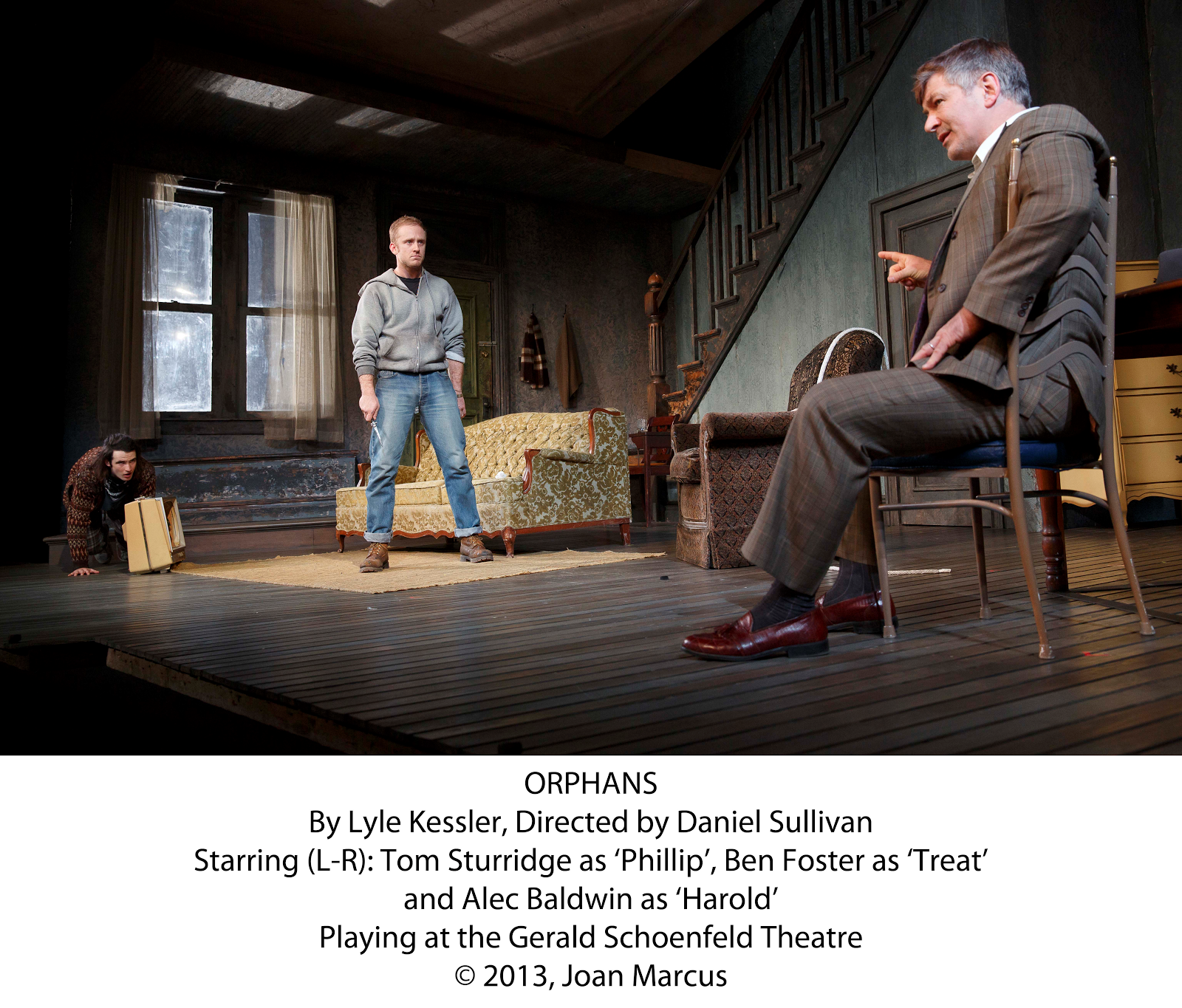
A stand-out performance by Tom Sturridge highlights the electrifying and terrifying Broadway revival of Lyle Kessler's dark and absurdest play Orphans, also starring Alec Baldwin ("30 Rock") and Ben Foster.
Older brother Treat (Foster) earns a living as a petty thief to take care of brother Phillip (Sturridge) who inhabits his own autistic word, where tuna fish and a bowl of mayonnaise are the meals of the day -- every day -- and where contact with the outside world is feared as potentially lethal. Phillip leaps around the furniture and occasionally looks out the window to observe passers by or marvels at the woman's high heel he secrets away.
One day, Treat decides to up the stakes from mugging to kidnapping when he encounters well--to-do businessman Harold (Baldwin). He and Phillip tie him up in their dilapidated north Philadelphia home (John Lee Beatty, set design) and prepare to collect a handsome ransom. The tables are turned, however, when Harold frees himself, but decides to stay. He befriends Phillip and hires the inept Treat as his body guard. Suddenly roles reverse as Treat's confidence deserts him and Phillip discovers that he can do a lot more than he thought -- especially those things Treat has been telling him he couldn't do all these years -- with Harold's help.
The play itself is bizarre, bringing to mind Martin McDonagh’s A Behanding in Spokane. To enjoy these works, you have to check reality and all reasoning at the door or you will spend all of your time thinking, "That would never happen," or "That doesn't make sense." If you are willing to do that here, you'll allow Kessler some room to explore human nature and relationships.
The biggest takeaway from this production, however, is Sturridge's dynamite performance (he has been nominated for a Tony Award for Best Actor in a Play and the play is up for best revival). His portrayal is at once physical, energetic, calm and gentle. With each gesture or mimic of another character, he takes the portrait to a deeper level. It's one of the most gripping and engrossing performances I have seen on stage in a while, even more so because he upstages Hollywood badboy Baldwin, the box-office draw for the show. Foster could be completely lost up there, but the steady direction of Daniel Sullivan keeps him in play.
Orphans plays at the Gerald Schoenfeld Theatre, 236 West 45th St., NYC through June 30. Tickets and info: http://www.orphansonbroadway.com/.
Christians might also like to know:
-- Language
-- God's name taken in vain
Wednesday, May 1, 2013
Quick Hit Theater Review: Jekyll & Hyde
![]() |
| Constantine Maroulis and Deborah Cox. Photo: Chris Bennion |
Music by Frank Wildhorn
Book and Lyrics by Leslie Bricusse
Directed and Choreographed by Jeff Calhoun
What's It All About?
The revival of that adaptation of Robert Louis Stevenson's tale about Doctor Henry Jekyll ("American Idol" finalist Constantie Maroulis) who uses himself as a guinea pig to find a cure for the dark side of human nature. Victorian society scoffs at his attempts to help those they would rather hide in asylums, so Jekyll becomes the test case for his own experiments. His potions unleash his alter-self, the cruel Edward Hyde who preys on prostitutes and fights with Henry to win control of his body. The laboratory is colorful, but ridiculous in nature. Tobin Cost designs it and the rest of the fractured looking sets that reflect the shattered nature of Henry's soul and designs the costumes as well. Unaware of the split personality overtaking Jekyll are his fiancee, Emma Carew (Teal Wicks) and Lucy Harris (Deborah Cox), the prostitute kind Henry befriends after she is forced to endure brutality by his Hyde self.
What are the Highlights?
What a treat to hear the lovely Wildhorn score on stage again. It birthed a number of classic tunes like "This is the Moment," "Take Me As I Am," and the show-stopping "A New Life." Anyone who has listened to the original Broadway cast recordings or the two concept albums that preceded it a few thousand times and are wondering whether anyone but Linda Eder can do Lucy's songs justice stop worrying. Cox, a Grammy nominated R&B artist, does them wonderfully. "Someone Like You" is truly beautiful. David Benoit stands out in the minor role of Spider, the repulsive owner of the dive where Lucy and the other girls of the night make their living.
What are the Lowlights?
Calhoun doesn't seem to urge Maroulis beyond singing for his old television competition crowd. Every song is delivered to evoke applause. Portraying the characters of Jekyll and Hyde (he does a better job with this one) gets put on a back burner. For the song "Confrontation," usually performed by the actor morphing back and forth between his good and bad selves, the task gets eliminated completely. . In a big let down, Jekyll simply sings a duet with a projected image of Hyde (Daniel Brodie does the projection design -- loved the image he creates for Hyde Park, by the way). Also disappointing is Wicks as Emma. She comes off as uppity and is much too harsh. We almost understand Henry's desire to yield to the dark side. And what's up with the sound (Ken Travis, design). It's way too loud and the mix is off.
More information:
Jekyll & Hyde runs through June 30 at the Marquis Theatre, 1535 Broadway, NYC. Tickets and info: http://www.jekyllandhydemusical.com/.
Christians might also like to know:
-- Violence
-- Sexual actions
-- The show doesn't post a Mature Advisory, but I would suggest it should have one. It's dark, mature material.
Quick Hit Theater Review: The Big Knife
The Big Knife
By Clifford Odets
Directed by Doug Hughes
Roundabout Theatre Company
What's It all About?
Well, you tell me. The second Odets play to grace a Broadway stage this season had me asking the same question as when I saw his Golden Boy back in December: "Of all the plays out there, why would you revive this one?" The testosterone-heavy, exposition-laden, heavy-on-the-long-winded speeches tale is about Charlie Castle (Bobby Cannavale), a movie star who is conflicted about signing a 14-year contract extension with sleazy studio head Marcus Hoff (Richard Kind) who has blackmail information on the star to keep him under his mafioso-type thumb.
What are the Highlights?
Strong performances from Cannavale and Kind and also from Marin Ireland, who plays Charlie's wife, Marion, the only woman on stage whose character gets a little development beyond being there to service the sexual needs of a man. She even does get to complain about being a doormat once (though she keeps taking him back after he cheats). One of the other "gals" likes it when her man physically hurts her.
What Are the Lowlights?
Too many to fully list here (why, oh, why this script, I ask again.) The play is full of ridiculously contrived moments to propel the action: one actor exits, then the phone rings; another character falls asleep before the next one enters a scene -- how convenient. It also contains lines that are so bad, they are funny:
More information:
The Big Knife runs through June 2 at American Airlines Theatre, 227 West 42nd St., NYC. Tickets and info: http://www.roundabouttheatre.org/Shows-Events/Big-Knife.aspx.
Christians might also like to know:
-- Language
-- Abortion
By Clifford Odets
Directed by Doug Hughes
Roundabout Theatre Company
What's It all About?
Well, you tell me. The second Odets play to grace a Broadway stage this season had me asking the same question as when I saw his Golden Boy back in December: "Of all the plays out there, why would you revive this one?" The testosterone-heavy, exposition-laden, heavy-on-the-long-winded speeches tale is about Charlie Castle (Bobby Cannavale), a movie star who is conflicted about signing a 14-year contract extension with sleazy studio head Marcus Hoff (Richard Kind) who has blackmail information on the star to keep him under his mafioso-type thumb.
What are the Highlights?
Strong performances from Cannavale and Kind and also from Marin Ireland, who plays Charlie's wife, Marion, the only woman on stage whose character gets a little development beyond being there to service the sexual needs of a man. She even does get to complain about being a doormat once (though she keeps taking him back after he cheats). One of the other "gals" likes it when her man physically hurts her.
What Are the Lowlights?
Too many to fully list here (why, oh, why this script, I ask again.) The play is full of ridiculously contrived moments to propel the action: one actor exits, then the phone rings; another character falls asleep before the next one enters a scene -- how convenient. It also contains lines that are so bad, they are funny:
- Never underestimate a man just because you don't know him.
- Boy, if I didn't love people so much, how I'd hate them.
- You have hell in you. Let's enjoy it.
- You can't think beyond the tips of your shoes.
- Go home. You're mother wants you.
More information:
The Big Knife runs through June 2 at American Airlines Theatre, 227 West 42nd St., NYC. Tickets and info: http://www.roundabouttheatre.org/Shows-Events/Big-Knife.aspx.
Christians might also like to know:
-- Language
-- Abortion
Theater Review: Here Lies Love
![]() |
By Lauren Yarger
Here Lies Love running Off-Broadway at the Public Theater quickly separates audience goers into one of two categories: The "young and hip" or the "old and traditional."
Attendees check their coats and bags at the door and enter a happening dance club, complete with flashing lights and video displays for an hour and a half of the dance club scene with a driving, pulsing beat (M.L. Dogg and Cody Spencer, sound design). Wranglers clad in fluorescent-pink jump suits direct the constantly moving crowd throughout the performance. There are no seats so if you aren't prepared (or able) to stand for the duration, you will have to invest in one of the few box seats available on a second level overlooking the action taking place on the floor. Where the DJ is housed for you "old and traditional" theatergoers.
Suddenly the crowd becomes the people of the Philippines and the story of former President and First Lady Ferdinand (Jose Llana) and Imeda (Ruthie Ann Miles) Marcos is playing out across five different staging platforms, all of which move and change during the presentation and through video projection (David Korins designs the set; Peter Nigrini designs the projections).
The exhilarating show was conceived by David Byrne (from the music world's Talking Heads and Luaka Bop), who writes the lyrics. He teams to write the score with Fatboy Slim, also known as Norman Cook who first rose to fame as the bassist with The Housemartins (additional music is by Tom Candey and J. Pardo). The genius behind making everything work is Director Alex Timbers who brought us that other nontraditional rock history musical, the riotously funny Bloody Bloody Andrew Jackson.
The part karaoke tribute (that was invented in the Philippines, we're told) and part history lesson about the couple's rise and fall is non-stop, with virtually no dialogue. Much of the action is presented through Annie-B Parson's fresh choreography. The actors make numerous costume changes (designed by Clint Ramos), some of them almost break-away to keep up with the pace (loved the printed A-line dresses).
When the jumpsuited ushers aren't directing you out of the way of the revolving center platform, the lighting by designer Justin Townsend guides you to the next bit of action. Once you leave, the contagious strains of the title song keep pulling you back to the experience.
Mostly young people, smiling and clearly enjoying the experience all the way through, comprised the crowd the night I attended. It's interactive, immersing theater with a 360-degree view and it quite possibly might change the theater experience as we know it. I'd like to think that because I managed to stand for duration and enjoyed the experience, though I normally loathe interactive theater, I can classify myself as belonging to the "young and hip" rather than to the "old and traditional" group. Or at least the "young and hip at heart" category.
Here Lies Love is extended at the The Public, 425 Lafayette St., NYC, through June 30. Performances Tuesday through Thursday at 8:30 pm; Friday and saturday at 5 and 9:30 pm; Sunday at 6 pm. Tickets start at $89: (212) 967-7555; www.publictheater.org.
Other information:
The show lasts about 100 minutes without intermission. There is no place to sit on the floor level or anywhere to put your bag down, so be prepared and wear comfortable shoes. Wheelchairs can be accommodated on the floor level. Dancing is ncouraged. warnings for smoke, haze, gunshots and loud music.
Christians might also like to know:
--Language
--Sexual diolague and activity
Tuesday, April 30, 2013
Theater Review: The Testament of Mary
Mary Wants Us to See Her in a New Light, but This Version of Jesus' Mother is Too Dark
By Lauren Yarger
She's angry and bitter. Afraid and cautious. She's not the virginal, almost-goddess to whom people still pray (especially if you're Catholic) and we get the impression that she doesn't pray much herself.
She's Mary, the mother of Jesus -- or at least how a 21st-Century writer and a talented actress want us to see her. The "truth should be spoken at least once in the world" The Testament of Mary's slogan screams at us, as though what we know about Mary, primarily from the bible, is totally in error.
Fiona Shaw, in a powerful and demanding solo performance, takes on the character created by Colm Toibin, adapted for the Broadway stage from his bestselling novella of the same name. Audiences entering the Walter Kerr Theatre are invited up on stage prior to the performance where various props and a live vulture are on display. Suddenly, Shaw walks out and takes a seat inside a glass room where candles have been placed almost in an altar-like fashion at her feet. The crowds filing up onto stage look like a procession in church on their way to view a relic or something (lighting designed by Jennifer Tipton highlights arches in the theater's ceiling to give a cathedral effect.)
But if anyone feels a stirring of the divine, a kinship with the blue-robed Mary that one might expect to find shining in a museum painting, the image is quickly stripped away -- stage hands obtrusively come out and dismantle the glass room (thankfully taking the vulture with them) and Mary sheds her royal robes to reveal a black tunic over leggings and boots. And the puzzling staging (what time period is this? How long ago did the crucifixion take place?) of the 90-minute soliloquy begins.
Smoking cigarettes taken from a pocket in a jacket that looks like it was bought in an Army surplus store (Ann Roth designs the costumes), Mary tells us she is being watched after the crucifixion and visitors (we assume that they are apostles, though she doesn't identify them) want to record her words and memories to promulgate their version of how and why her son was put to death. They aren't interested in the truth.
She hasn't slept much and still can't even mention Jesus' name, she tells us. She fears that if she utters it "something inside me will break." Not only was she estranged from Jesus during his ministry, denying that she was one of his followers, but she also left him to die alone on the cross. She snuck away because she feared for her own life, she says. The stress eats away at her much like that vulture might if given a chance and she constantly paces around the stage. Poorly directed by Deborah Warner, she busies herself endlessly with senseless, distracting tasks like shifting a ladder around, moving barbed wire, chopping a fish or constantly splashing water on herself from a modern spigot, which spills into a sort of pool or well.
More unnecessary movement is added with scrims and sections of backdropping that move and reveal shades of other colored backgrounds (Tom Pye designs the set). The tall expanse dwarfs Mary while keeping focus on a lone white tree limb upstage with what looks like a bird -- hopefully not that live vulture -- perched on a wagon wheel on top. Most of the action takes place in dim lighting and is accented by moody sounds and original music by Mel Mercer.
She's not happy, this Mary, and she can't contain her disappointment in Jesus, who became rather haughty in his fame and who hung out with a bunch of "misfits." She discounts some of his miracles, bringing into question whether wine already was in the casks at the wedding at Cana. She implies that Jesus was cruel in waking Lazarus from the dead since his friend only continued to suffer horribly after being called forth from the tomb. She depicts Lazarus' sister Martha as some sort of brainwashed zealot.
The main idea of Toibin's fable is that we're supposed to relate to Mary as a real woman, especially as a mother who is grieving. I can go there with him on that. Mary was a real woman -- not some sinless goddess -- and she certainly would have grieved the loss of her son. She's an inspiring figure and we don't know enough about her and I would like to know more. The play's best moment, in fact, comes when Mary recounts first learning that her son would be crucified. She recalls a crucifixion she once witnessed. As the memory of that long-ago horror sharpens, so does her understanding of what will happen to her son and Shaw skillfully conveys the raw terror and the accompanying suffering and grief of a mother unable to help her child. She physically draws into a pose that shows that she is being crucified as well. Yes, it could have happened just like that. It's a beautiful scene. I wish they'd all been like that.
Where Toibin left me (and Mary, some might argue) behind on this journey is when he walked down a dark path and asked us to leave behind everything we know about Mary -- and Jesus for that matter. Mary implies that Jesus was no immaculate conception. She says that since she wasn't there (and therefore could hardly have inspired a Pietà) she doesn't know whether he was buried after dying on the cross, implying that the tomb might have been empty all along. She says stories of his resurrection were birthed when she and Mary (Lazarus' other sister) somehow had the exact same dream about Jesus appearing to them. A coincidence that got recorded and blown out of all proportion, it seems.
Toibin's play starts at the end, however. There is no room for reinventing the beginning. The only reason we can join Mary at this point in her life is because we know the story of her son's life and death as told in the bible an other historical writings that survive from the time. Without that "backstory," we would have no idea who this woman is or what she is talking about. So to throw away what we know just because this Mary smokes, drinks and gets naked (yes, Shaw ends up completely nude in the attempt to "strip bare" this character), requires having more faith in the playwright and his imagination than in eyewitness accounts, abundant early first-century accounts and many Messianic prophecies fulfilled by Jesus (and by no one else in history). Pretty good for someone stupid enough to hang out with a bunch of misfits (at least one of whom was his brother and also Mary's kid. Did she forget that?)..... Sorry, it's not believable and neither is that story about two people having the exact same dream.
Despite all that, The Testament of Mary has received Tony and Outer Critics Circle nominations for Best Play this season.Shaw is nominated in the Outstanding Solo Performance category for the Outer Critics Circle Awards. It's deserved. She gives a strong performance and imbues Mary with a female perspective missing in the novella, where Toibin's male voice isn't disguised in character's first person narrative.
Mary only gets to tell her story a few more times on Broadway, however. The show, originally scheduled to run through June 16, has announced an early closing of its run this Sunday. For information and tickets: http://www.testamentonbroadway.com/.
Christians might also like to know:
-- Show posts a Mature advisory
-- Nudity
By Lauren Yarger
She's angry and bitter. Afraid and cautious. She's not the virginal, almost-goddess to whom people still pray (especially if you're Catholic) and we get the impression that she doesn't pray much herself.
She's Mary, the mother of Jesus -- or at least how a 21st-Century writer and a talented actress want us to see her. The "truth should be spoken at least once in the world" The Testament of Mary's slogan screams at us, as though what we know about Mary, primarily from the bible, is totally in error.
Fiona Shaw, in a powerful and demanding solo performance, takes on the character created by Colm Toibin, adapted for the Broadway stage from his bestselling novella of the same name. Audiences entering the Walter Kerr Theatre are invited up on stage prior to the performance where various props and a live vulture are on display. Suddenly, Shaw walks out and takes a seat inside a glass room where candles have been placed almost in an altar-like fashion at her feet. The crowds filing up onto stage look like a procession in church on their way to view a relic or something (lighting designed by Jennifer Tipton highlights arches in the theater's ceiling to give a cathedral effect.)
But if anyone feels a stirring of the divine, a kinship with the blue-robed Mary that one might expect to find shining in a museum painting, the image is quickly stripped away -- stage hands obtrusively come out and dismantle the glass room (thankfully taking the vulture with them) and Mary sheds her royal robes to reveal a black tunic over leggings and boots. And the puzzling staging (what time period is this? How long ago did the crucifixion take place?) of the 90-minute soliloquy begins.
Smoking cigarettes taken from a pocket in a jacket that looks like it was bought in an Army surplus store (Ann Roth designs the costumes), Mary tells us she is being watched after the crucifixion and visitors (we assume that they are apostles, though she doesn't identify them) want to record her words and memories to promulgate their version of how and why her son was put to death. They aren't interested in the truth.
She hasn't slept much and still can't even mention Jesus' name, she tells us. She fears that if she utters it "something inside me will break." Not only was she estranged from Jesus during his ministry, denying that she was one of his followers, but she also left him to die alone on the cross. She snuck away because she feared for her own life, she says. The stress eats away at her much like that vulture might if given a chance and she constantly paces around the stage. Poorly directed by Deborah Warner, she busies herself endlessly with senseless, distracting tasks like shifting a ladder around, moving barbed wire, chopping a fish or constantly splashing water on herself from a modern spigot, which spills into a sort of pool or well.
More unnecessary movement is added with scrims and sections of backdropping that move and reveal shades of other colored backgrounds (Tom Pye designs the set). The tall expanse dwarfs Mary while keeping focus on a lone white tree limb upstage with what looks like a bird -- hopefully not that live vulture -- perched on a wagon wheel on top. Most of the action takes place in dim lighting and is accented by moody sounds and original music by Mel Mercer.
She's not happy, this Mary, and she can't contain her disappointment in Jesus, who became rather haughty in his fame and who hung out with a bunch of "misfits." She discounts some of his miracles, bringing into question whether wine already was in the casks at the wedding at Cana. She implies that Jesus was cruel in waking Lazarus from the dead since his friend only continued to suffer horribly after being called forth from the tomb. She depicts Lazarus' sister Martha as some sort of brainwashed zealot.
The main idea of Toibin's fable is that we're supposed to relate to Mary as a real woman, especially as a mother who is grieving. I can go there with him on that. Mary was a real woman -- not some sinless goddess -- and she certainly would have grieved the loss of her son. She's an inspiring figure and we don't know enough about her and I would like to know more. The play's best moment, in fact, comes when Mary recounts first learning that her son would be crucified. She recalls a crucifixion she once witnessed. As the memory of that long-ago horror sharpens, so does her understanding of what will happen to her son and Shaw skillfully conveys the raw terror and the accompanying suffering and grief of a mother unable to help her child. She physically draws into a pose that shows that she is being crucified as well. Yes, it could have happened just like that. It's a beautiful scene. I wish they'd all been like that.
Where Toibin left me (and Mary, some might argue) behind on this journey is when he walked down a dark path and asked us to leave behind everything we know about Mary -- and Jesus for that matter. Mary implies that Jesus was no immaculate conception. She says that since she wasn't there (and therefore could hardly have inspired a Pietà) she doesn't know whether he was buried after dying on the cross, implying that the tomb might have been empty all along. She says stories of his resurrection were birthed when she and Mary (Lazarus' other sister) somehow had the exact same dream about Jesus appearing to them. A coincidence that got recorded and blown out of all proportion, it seems.
Toibin's play starts at the end, however. There is no room for reinventing the beginning. The only reason we can join Mary at this point in her life is because we know the story of her son's life and death as told in the bible an other historical writings that survive from the time. Without that "backstory," we would have no idea who this woman is or what she is talking about. So to throw away what we know just because this Mary smokes, drinks and gets naked (yes, Shaw ends up completely nude in the attempt to "strip bare" this character), requires having more faith in the playwright and his imagination than in eyewitness accounts, abundant early first-century accounts and many Messianic prophecies fulfilled by Jesus (and by no one else in history). Pretty good for someone stupid enough to hang out with a bunch of misfits (at least one of whom was his brother and also Mary's kid. Did she forget that?)..... Sorry, it's not believable and neither is that story about two people having the exact same dream.
Despite all that, The Testament of Mary has received Tony and Outer Critics Circle nominations for Best Play this season.Shaw is nominated in the Outstanding Solo Performance category for the Outer Critics Circle Awards. It's deserved. She gives a strong performance and imbues Mary with a female perspective missing in the novella, where Toibin's male voice isn't disguised in character's first person narrative.
Mary only gets to tell her story a few more times on Broadway, however. The show, originally scheduled to run through June 16, has announced an early closing of its run this Sunday. For information and tickets: http://www.testamentonbroadway.com/.
Christians might also like to know:
-- Show posts a Mature advisory
-- Nudity
Kinky Boots, Matilda Lead Tony Award Nominations
![]() |
| Billy Porter and The Angels (L-R: Kyle Post, Kevin Smith Kirkwood, Joey Taranto, and Paul Canaan) in Kinky Boots. Photo: Matthew Murphy |
The Tonys will be awarded Sunday,
June 9 at Radio City Music Hall, NYC. Live telecast will begin at 8 pm on CBS.
More info: http://www.tonyawards.com/index.html.
The 2013 Nominations:
Best Play
The
Assembled Parties by Richard Greenberg
Lucky
Guy by
Nora Ephron
The
Testament of Mary by Colm Toíbín
Vanya
and Sonia and Masha and Spike by Christopher Durang
Best Musical
Bring
It On: The Musical
A
Christmas Story, The Musical
Kinky
Boots
Matilda
The Musical
Best Revival of a Play
Golden
Boy
Orphans
The
Trip to Bountiful
Who’s
Afraid of Virginia Woolf?
Best Revival of a Musical
Annie
The
Mystery of Edwin Drood
Pippin
Rodgers
and Hammerstein’s Cinderella
Best Book
of a Musical
A
Christmas Story, The Musical by Joseph
Robinette
Kinky
Boots by Harvey Fierstein
Matilda
The Musical by Dennis
Kelly
Rodgers
and Hammerstein’s Cinderella by Douglas
Carter Beane
Best Original Score (Music and/or Lyrics) Written for the Theatre
A
Christmas Story, The Musical
Music and Lyrics: Benj Pasek and
Justin Paul
Hands on a
Hardbody
Music: Trey Anastasio and Amanda
Green; Lyrics: Amanda Green
Kinky
Boots
Music & Lyrics: Cyndi Lauper
Matilda
The Musical
Music & Lyrics: Tim Minchin
Best Performance by an Actor in a Leading Role in a Play
Tom Hanks, Lucky Guy
Nathan Lane, The Nance
Tracy Letts, Who’s Afraid of Virginia Woolf?
David Hyde Pierce, Vanya and Sonia and Masha and Spike
Tom Sturridge, Orphans
Nathan Lane, The Nance
Tracy Letts, Who’s Afraid of Virginia Woolf?
David Hyde Pierce, Vanya and Sonia and Masha and Spike
Tom Sturridge, Orphans
Best Performance by an Actress in a Leading Role in a Play
Laurie Metcalf, The Other Place
Amy Morton, Who’s Afraid of Virginia Woolf?
Kristine Nielsen, Vanya and Sonia and Masha and Spike
Holland Taylor, Ann
Cicely Tyson, The Trip to Bountiful
Amy Morton, Who’s Afraid of Virginia Woolf?
Kristine Nielsen, Vanya and Sonia and Masha and Spike
Holland Taylor, Ann
Cicely Tyson, The Trip to Bountiful
Best Performance by an Actor in a Leading Role in a Musical
Bertie Carvel, Matilda The
Musical
Santino Fontana, Rodgers + Hammerstein’s Cinderella
Rob McClure, Chaplin
Billy Porter, Kinky Boots
Stark Sands, Kinky Boots
Santino Fontana, Rodgers + Hammerstein’s Cinderella
Rob McClure, Chaplin
Billy Porter, Kinky Boots
Stark Sands, Kinky Boots
Best Performance by an Actress in a Leading Role in a Musical
Stephanie J. Block, The Mystery
of Edwin Drood
Carolee Carmello, Scandalous
Valisia LeKae, Motown The Musical
Patina Miller, Pippin
Laura Osnes, Rodgers + Hammerstein’s Cinderella
Carolee Carmello, Scandalous
Valisia LeKae, Motown The Musical
Patina Miller, Pippin
Laura Osnes, Rodgers + Hammerstein’s Cinderella
Best Performance by an Actor in a Featured Role in a Play
Danny Burstein, Golden Boy
Richard Kind, The Big Knife
Billy Magnussen, Vanya and Sonia and Masha and Spike
Tony Shalhoub, Golden Boy
Courtney B. Vance, Lucky Guy
Richard Kind, The Big Knife
Billy Magnussen, Vanya and Sonia and Masha and Spike
Tony Shalhoub, Golden Boy
Courtney B. Vance, Lucky Guy
Best Performance by an Actress in a Featured Role in a Play
Carrie Coon, Who’s Afraid of
Virginia Woolf?
Shalita Grant, Vanya and Sonia and Masha and Spike
Judith Ivey, The Heiress
Judith Light, The Assembled Parties
Condola Rashad, The Trip to Bountiful
Shalita Grant, Vanya and Sonia and Masha and Spike
Judith Ivey, The Heiress
Judith Light, The Assembled Parties
Condola Rashad, The Trip to Bountiful
Best Performance by an Actor in a Featured Role in a Musical
Charl Brown, Motown The Musical
Keith Carradine, Hands on a Hardbody
Will Chase, The Mystery of Edwin Drood
Gabriel Ebert, Matilda The Musical
Terrence Mann, Pippin
Keith Carradine, Hands on a Hardbody
Will Chase, The Mystery of Edwin Drood
Gabriel Ebert, Matilda The Musical
Terrence Mann, Pippin
Best Performance by an Actress in a Featured Role in a Musical
Annaleigh Ashford, Kinky Boots
Victoria Clark, Rodgers + Hammerstein’s Cinderella
Andrea Martin, Pippin
Keala Settle, Hands on a Hardbody
Lauren Ward, Matilda The Musical
Victoria Clark, Rodgers + Hammerstein’s Cinderella
Andrea Martin, Pippin
Keala Settle, Hands on a Hardbody
Lauren Ward, Matilda The Musical
Best Scenic Design of a Play
John Lee Beatty, The Nance
Santo Loquasto, The Assembled Parties
David Rockwell, Lucky Guy
Michael Yeargan, Golden Boy
Santo Loquasto, The Assembled Parties
David Rockwell, Lucky Guy
Michael Yeargan, Golden Boy
Best Scenic Design of a Musical
Rob Howell, Matilda The Musical
Anna Louizos, The Mystery of Edwin Drood
Scott Pask, Pippin
David Rockwell, Kinky Boots
Anna Louizos, The Mystery of Edwin Drood
Scott Pask, Pippin
David Rockwell, Kinky Boots
Best Costume Design of a Play
Soutra Gilmour, Cyrano de
Bergerac
Ann Roth, The Nance
Albert Wolsky, The Heiress
Catherine Zuber, Golden Boy
Ann Roth, The Nance
Albert Wolsky, The Heiress
Catherine Zuber, Golden Boy
Best Costume Design of a Musical
Gregg Barnes, Kinky Boots
Rob Howell, Matilda The Musical
Dominique Lemieux, Pippin
William Ivey Long, Rodgers + Hammerstein’s Cinderella
Rob Howell, Matilda The Musical
Dominique Lemieux, Pippin
William Ivey Long, Rodgers + Hammerstein’s Cinderella
Best Lighting Design of a Play
Jules Fisher & Peggy Eisenhauer,
Lucky Guy
Donald Holder, Golden Boy
Jennifer Tipton, The Testament of Mary
Japhy Weideman, The Nance
Donald Holder, Golden Boy
Jennifer Tipton, The Testament of Mary
Japhy Weideman, The Nance
Best Lighting Design of a Musical
Kenneth Posner, Kinky Boots
Kenneth Posner, Pippin
Kenneth Posner, Rodgers + Hammerstein’s Cinderella
Hugh Vanstone, Matilda The Musical
Kenneth Posner, Pippin
Kenneth Posner, Rodgers + Hammerstein’s Cinderella
Hugh Vanstone, Matilda The Musical
Best Sound Design of a Play
John Gromada, The Trip to
Bountiful
Mel Mercier, The Testament of Mary
Leon Rothenberg, The Nance
Peter John Still and Marc Salzberg, Golden Boy
Mel Mercier, The Testament of Mary
Leon Rothenberg, The Nance
Peter John Still and Marc Salzberg, Golden Boy
Best Sound Design of a Musical
Jonathan Deans & Garth Helm, Pippin
Peter Hylenski, Motown The Musical
John Shivers, Kinky Boots
Nevin Steinberg, Rodgers + Hammerstein’s Cinderella
Peter Hylenski, Motown The Musical
John Shivers, Kinky Boots
Nevin Steinberg, Rodgers + Hammerstein’s Cinderella
Best Direction of a Play
Pam MacKinnon, Who’s Afraid of
Virginia Woolf?
Nicholas Martin, Vanya and Sonia and Masha and Spike
Bartlett Sher, Golden Boy
George C. Wolfe, Lucky Guy
Nicholas Martin, Vanya and Sonia and Masha and Spike
Bartlett Sher, Golden Boy
George C. Wolfe, Lucky Guy
Best Direction of a Musical
Scott Ellis, The Mystery of
Edwin Drood
Jerry Mitchell, Kinky Boots
Diane Paulus, Pippin
Matthew Warchus, Matilda The Musical
Jerry Mitchell, Kinky Boots
Diane Paulus, Pippin
Matthew Warchus, Matilda The Musical
Best
Choreography
Andy Blankenbuehler, Bring It
On: The Musical
Peter Darling, Matilda The Musical
Jerry Mitchell, Kinky Boots
Chet Walker, Pippin
Peter Darling, Matilda The Musical
Jerry Mitchell, Kinky Boots
Chet Walker, Pippin
Best Orchestrations
Chris Nightingale, Matilda The
Musical
Stephen Oremus, Kinky Boots
Ethan Popp & Bryan Crook, Motown The Musical
Stephen Oremus, Kinky Boots
Ethan Popp & Bryan Crook, Motown The Musical
Danny Troob, Rodgers +
Hammerstein’s Cinderella
* * *
Recipients of Awards and Honors in
Non-competitive Categories
Special Tony Award for Lifetime
Achievement in the Theatre
Bernard Gersten
Paul Libin
Ming Cho Lee
Regional Theatre Award
Huntington Theatre Company, Boston,
MA
Isabelle Stevenson Award
Larry Kramer
Tony Honor for Excellence in the
Theatre
Career Transition For Dancers
William Craver
Peter Lawrence
The Lost Colony
The four actresses who created the title role of Matilda The Musical on Broadway - Sophia
Gennusa, Oona Laurence, Bailey Ryon and Milly Shapiro
Monday, April 29, 2013
Giant, Hands on a Hardbody Head Drama Desk Nominations
![]() |
The Drama Desk nominees will receive their official nomination certificates at the nominees’ reception on Wednesday, May 8 at The Grand Salon at the JW Marriott Essex House.
The 58th Annual Drama Desk Awards will take place on Sunday, May 19 8 pm at The Town Hall in Manhattan. http://www.dramadeskawards.com/
DRAMA DESK NOMINATIONS FOR THE 2012-2013 SEASON
Outstanding Play
Annie Baker, The Flick
Christopher Durang, Vanya and Sonia and Masha and Spike
Joe Gilford, Finks
Richard Greenberg, The Assembled Parties
Amy Herzog, Belleville
Deanna Jent, Falling
Richard Nelson, Sorry
Outstanding Musical
A Christmas Story: The Musical
Giant
Hands on a Hardbody
Here Lies Love
Matilda
Natasha, Pierre and The Great Comet of 1812
The Other Josh Cohen
Outstanding Revival of a Play
Edward Albee's Who's Afraid of Virginia Woolf?
Golden Boy
Good Person of Szechwan
The Piano Lesson
The Trip to Bountiful
Uncle Vanya
Outstanding Revival of a Musical or Revue
Passion
Pippin
Rodgers and Hammerstein's Cinderella
The Golden Land
The Mystery of Edwin Drood
Working: A Musical
Outstanding Actor in a Play
Reed Birney, Uncle Vanya
Daniel Everidge, Falling
Tom Hanks, Lucky Guy
Shuler Hensley, The Whale
Nathan Lane, The Nance
Tracy Letts, Edward Albee's Who's Afraid of Virginia Woolf?
Outstanding Actress in a Play
Maria Dizzia, Belleville
Amy Morton, Edward Albee's Who's Afraid of Virginia Woolf?
Julia Murney, Falling
Vanessa Redgrave, The Revisionist
Miriam Silverman, Finks
Cicely Tyson, The Trip to Bountiful
Outstanding Actor in a Musical
Eric Anderson, Soul Doctor
Brian d’Arcy James, Giant
Jim Norton, The Mystery of Edwin Drood
Billy Porter, Kinky Boots
Steve Rosen, The Other Josh Cohen
Ryan Silverman, Passion
Anthony Warlow, Annie
Outstanding Actress in a Musical
Kate Baldwin, Giant
Stephanie J. Block, The Mystery of Edwin Drood
Carolee Carmello, Scandalous
Lindsay Mendez, Dogfight
Donna Murphy, Into the Woods
Laura Osnes, Rodgers and Hammerstein's Cinderella
Jenny Powers, Donnybrook!
Outstanding Featured Actor in a Play
Chuck Cooper, The Piano Lesson
Peter Friedman, The Great God Pan
Richard Kind, The Big Knife
Aaron Clifton Moten, The Flick
Brían F. O’Byrne, If There Is I Haven’t Found It Yet
Tony Shalhoub, Golden Boy
Outstanding Featured Actress in a Play
Tasha Lawrence, The Whale
Judith Light, The Assembled Parties
Kellie Overbey, Sleeping Rough
Maryann Plunkett, Sorry
Condola Rashad, The Trip to Bountiful
Laila Robins, Sorry
Outstanding Featured Actor in a Musical
Stephen Bogardus, Passion
John Bolton, A Christmas Story: The Musical
Keith Carradine, Hands on a Hardbody
Bertie Carvel, Matilda
John Dossett, Giant
Andy Karl, The Mystery of Edwin Drood
Outstanding Featured Actress in a Musical
Annaleigh Ashford, Kinky Boots
Melissa Errico, Passion
Andrea Martin, Pippin
Jessie Mueller, The Mystery of Edwin Drood
Christiane Noll, Chaplin: The Musical
Keala Settle, Hands on a Hardbody
Kate Wetherhead, The Other Josh Cohen
Outstanding Director of a Play
Lear Debessonet, Good Person of Szechwan
Sam Gold, Uncle Vanya
Ed Sylvanus Iskandar, Restoration Comedy
Pam MacKinnon, Edward Albee’s Who’s Afraid of Virginia Woolf?
Lynne Meadow, The Assembled Parties
Ruben Santiago-Hudson, The Piano Lesson
Outstanding Director of a Musical
Andy Blankenbuehler, Bring It On: The Musical
Rachel Chavkin, Natasha, Pierre and The Great Comet of 1812
John Doyle, Passion
Diane Paulus, Pippin
Emma Rice, The Wild Bride
Alex Timbers, Here Lies Love
Matthew Warchus, Matilda
Outstanding Choreography
Andy Blankenbuehler, Bring It On: The Musical
Warren Carlyle, A Christmas Story: The Musical
Peter Darling, Matilda
Josh Rhodes, Rodgers and Hammerstein’s Cinderella
Sergio Trujillo, Hands on a Hardbody
Chet Walker and Gypsy Snider, Pippin
Outstanding Music
Trey Anastasio and Amanda Green, Hands on a Hardbody
David Byrne and Fatboy Slim, Here Lies Love
Michael John LaChiusa, Giant
Dave Malloy, Natasha, Pierre and The Great Comet of 1812
Benj Pasek and Justin Paul, A Christmas Story: The Musical
David Rossmer and Steve Rosen, The Other Josh Cohen
Outstanding Lyrics
Amanda Green, Hands on a Hardbody
Amanda Green and Lin-Manuel Miranda, Bring It On: The Musical
Michael John LaChiusa, Giant
Dave Malloy, Natasha, Pierre & The Great Comet of 1812
Tim Minchin, Matilda
David Rossmer and Steve Rosen, The Other Josh Cohen
Outstanding Book of a Musical
Dennis Kelly, Matilda
Sybille Pearson, Giant
Joseph Robinette, A Christmas Story: The Musical
David Rossmer and Steve Rosen, The Other Josh Cohen
Jeff Whitty, Bring It On: The Musical
Doug Wright, Hands on a Hardbody
Outstanding Orchestrations
Trey Anastasio and Don Hart, Hands on a Hardbody
Larry Blank, A Christmas Story: The Musical
Bruce Coughlin, Giant
Larry Hochman, Chaplin: The Musical
Steve Margoshes, Soul Doctor
Danny Troob, Rodgers and Hammerstein's Cinderella
Outstanding Music in a Play
César Alvarez with The Lisps, Good Person of Szechwan
Jiří Kadeřábek, Mahir Cetiz, and Ana Milosavljevic, Act Before You Speak: The Tragical
History of Hamlet, Prince of Denmark
Glen Kelly, The Nance
Eugene Ma, The Man Who Laughs
Steve Martin, As You Like It
Jane Wang, Strange Tales of Liaozhai
Outstanding Revue
Forbidden Broadway: Alive and Kicking!
Old Hats
Old Jews Telling Jokes
Outstanding Set Design
Rob Howell, Matilda
Mimi Lien, The Whale
Santo Loquasto, The Assembled Parties
Anna Louizos, The Mystery of Edwin Drood
Michael Yeargan, Golden Boy
David Zinn, The Flick
Outstanding Costume Design
Amy Clark and Martin Pakledinaz, Chaplin: The Musical
Dominique Lemieux, Pippin
William Ivey Long, Rodgers and Hammerstein’s Cinderella
Chris March, Chris March's The Butt-Cracker Suite! A Trailer Park Ballet
Loren Shaw, Restoration Comedy
Paloma Young, Natasha, Pierre and The Great Comet of 1812
Outstanding Lighting Design
Ken Billington, Chaplin: The Musical
Jane Cox, Passion
Kenneth Posner, Pippin
Justin Townsend, Here Lies Love
Daniel Winters, The Man Who Laughs
Scott Zielinski, A Civil War Christmas
Outstanding Projection Design
Jon Driscoll, Chaplin: The Musical
Wendall K. Harrington, Old Hats
Peter Nigrini, Here Lies Love
Darrel Maloney, Checkers
Pedro Pires, Cirque du Soleil: Totem
Aaron Rhyne, Wild With Happy
Outstanding Sound Design in a Musical
Steve Canyon Kennedy, Hands on a Hardbody
Scott Lehrer and Drew Levy, Chaplin: The Musical
Tony Meola, The Mystery of Edwin Drood
Brian Ronan, Bring It On: The Musical
Brian Ronan, Giant
Dan Moses Schreier, Passion
Outstanding Sound Design in a Play
Ien DeNio, The Pilo Family Circus
Steve Fontaine, Last Man Club
Christian Frederickson, Through the Yellow Hour
Lindsay Jones, Wild With Happy
Mel Mercier, The Testament of Mary
Fergus O’Hare, Macbeth
Outstanding Solo Performance
Joel de la Fuente, Hold These Truths
Kathryn Hunter, Kafka’s Monkey
Bette Midler, I’ll Eat You Last: A Chat with Sue Mengers
Julian Sands, A Celebration of Harold Pinter
Holland Taylor, Ann
Michael Urie, Buyer and Cellar
Unique Theatrical Experience
Bello Mania
Chris March's The Butt-Cracker Suite! A Trailer Park Ballet
Cirque Du Soleil: Totem
That Play: A Solo Macbeth
The Fazzino Ride
The Man Who Laughs
The following awards were voted by the Nominating Committee and will be presented by the Drama Desk at its awards ceremony:
Outstanding Ensemble Performance
Working: A Musical
Marie-France Arcilla, Joe Cassidy, Donna Lynne Champlin, Jay Armstrong Johnson, Nehal Joshi, and Kenita R. Miller
Special Awards:
• To The New York Musical Theatre Festival (NYMF), Isaac Robert Hurwitz, Executive Director and Producer: For a decade of creating and nurturing new musical theater, ensuring the future of this essential art form.
• To Wakka Wakka (Gabrielle Brechner, Kirjan Waage, and Gwendolyn Warnock): For sophisticated puppet theater, as represented by this season’s SAGA, that explores with wit, imagination, and insight serious issues of our times.
• To Jayne Houdyshell: For her artistry as an exceptionally versatile and distinctive Broadway and Off-Broadway performer.
• To Samuel D. Hunter: His empathic and indelible play The Whale affirms his arrival as a distinguished dramatist who depicts the human condition.
• To Maruti Evans, the Sam Norkin Off-Broadway Award: For his ingenious lighting designs, reflecting an exquisite and bold theatrical aesthetic. This season’s The Pilo Family Circus and Tiny Dynamite confirm his incandescent creativity.
Subscribe to:
Posts (Atom)
Custom Search
Our reviews are professional reviews written without a religious bias. At the end of them, you can find a listing of language, content or theological issues that Christians might want to know about when deciding which shows to see.
** Mature indicates that the show has posted an advisory because of content. Usually this means I would recommend no one under the age of 16 attend.
Theater Critic Lauren Yarger
My Bio
Lauren Yarger has written, directed and produced numerous shows and special events for both secular and Christian audiences. She co-wrote a Christian musical version of “A Christmas Carol” which played to sold-out audiences of over 3,000 in Vermont and was awarded the Vermont Bessie (theater and film awards) for “People’s Choice for Theatre.” She also has written two other dinner theaters, sketches for church services and devotions for Christian artists. Her play concept, "From Reel to Real: The Jennifer O'Neill Story" was presented as part of the League of professional Theatre Women's Julia's reading Room Series in New York.
Shifting from reviewing to producing, Yarger owns Gracewell Productions, which produced the Table Reading Series at the Palace Theater in Waterbury, CT. She trained for three years in the Broadway League’s Producer Development Program, completed the Commercial Theater Institute's Producing Intensive and other training and produced a one-woman musical about Mary Magdalene that toured nationally and closed with an off-Broadway run.
She was a Fellow at the National Critics Institute at the O'Neill Theater Center in Waterford, CT. She wrote reviews of Broadway and Off-Broadway theater (the only ones you can find in the US with an added Christian perspective) at http://reflectionsinthelight.blogspot.com/.
She is editor of The Connecticut Arts Connection (http://ctarts.blogspot.com), an award-winning website featuring theater and arts news for the state. She was a contributing editor for BroadwayWorld.com. She previously served as theater reviewer for the Manchester Journal-Inquirer, Connecticut theater editor for CurtainUp.com and as Connecticut and New York reviewer for American Theater Web.
She is a Co-Founder of the Connecticut Chapter of the League of Professional Theatre Women. She is a former vice president and voting member of The Drama Desk.
She is a freelance writer and playwright (member Dramatists Guild of America). She is a member if the The Outer Critics Circle (producer of the annual awards ceremony) and a member of The League of Professional Theatre Women, serving as Co-Founder of the Connecticut Chapter. Yarger was a book reviewer for Publishers Weekly A former newspaper editor and graduate of the University of Missouri’s School of Journalism, Yarger also worked in arts management for the Bushnell Center for the Performing Arts, the Hartford Symphony Orchestra and served for nine years as the Executive Director of Masterwork Productions, Inc. She lives with her husband in West Granby, CT. They have two adult children.
Copyright
All material is copyright 2008- 2024 by Lauren Yarger. Reviews and articles may not be reprinted without permission. Contact reflectionsinthelight@gmail.com
Search
Key to Content Notes:
God's name taken in vain -- means God or Jesus is used in dialogue without speaking directly to or about them.
Language -- means some curse words are used. "Minor" usually means the words are not too strong or that it only occurs once or twice throughout the show.
Strong Language -- means some of the more heavy duty curse words are used.
Nudity -- means a man or woman's backside, a man's lower front or a woman's front are revealed.
Scantily clad -- means actors' private areas are technically covered, but I can see a lot of them.
Sexual Language -- means the dialogue contains sexually explicit language but there's no action.
Sexual Activity -- means a man and woman are performing sexual acts.
Adultery -- Means a married man or woman is involved sexually with someone besides their spouse. If this is depicted with sexual acts on stage, the list would include "sexual activity" as well.
Sex Outside of Marriage -- means a man and woman are involved sexually without being married. If this is depicted sexually on stage, the list would include "sexual activity" as well.
Homosexuality -- means this is in the show, but not physically depicted.
Homosexual activity -- means two persons of the same sex are embracing/kissing. If they do more than that, the list would include "sexual activity" as well.
Cross Dresser -- Means someone is dressing as the opposite sex. If they do more than that on stage the listing would include the corresponding "sexual activity" and/or "homosexual activity" as well.
Cross Gender -- A man is playing a female part or a woman is playing a man's part.
Suggestive Dancing -- means dancing contains sexually suggestive moves.
Derogatory (category added Fall 2012) Language or circumstances where women or people of a certain race are referred to or treated in a negative and demeaning manner.
Other content matters such as torture, suicide, or rape will be noted, with details revealed only as necessary in the review itself.
The term "throughout" added to any of the above means it happens many times throughout the show.
Language -- means some curse words are used. "Minor" usually means the words are not too strong or that it only occurs once or twice throughout the show.
Strong Language -- means some of the more heavy duty curse words are used.
Nudity -- means a man or woman's backside, a man's lower front or a woman's front are revealed.
Scantily clad -- means actors' private areas are technically covered, but I can see a lot of them.
Sexual Language -- means the dialogue contains sexually explicit language but there's no action.
Sexual Activity -- means a man and woman are performing sexual acts.
Adultery -- Means a married man or woman is involved sexually with someone besides their spouse. If this is depicted with sexual acts on stage, the list would include "sexual activity" as well.
Sex Outside of Marriage -- means a man and woman are involved sexually without being married. If this is depicted sexually on stage, the list would include "sexual activity" as well.
Homosexuality -- means this is in the show, but not physically depicted.
Homosexual activity -- means two persons of the same sex are embracing/kissing. If they do more than that, the list would include "sexual activity" as well.
Cross Dresser -- Means someone is dressing as the opposite sex. If they do more than that on stage the listing would include the corresponding "sexual activity" and/or "homosexual activity" as well.
Cross Gender -- A man is playing a female part or a woman is playing a man's part.
Suggestive Dancing -- means dancing contains sexually suggestive moves.
Derogatory (category added Fall 2012) Language or circumstances where women or people of a certain race are referred to or treated in a negative and demeaning manner.
Other content matters such as torture, suicide, or rape will be noted, with details revealed only as necessary in the review itself.
The term "throughout" added to any of the above means it happens many times throughout the show.
Reviewing Policy
I receive free seats to Broadway and Off-Broadway shows made available to all voting members of the Outer Critics Circle. Journalistically, I provide an unbiased review and am under no obligation to make positive statements. Sometimes shows do not make tickets available to reviewers. If these are shows my readers want to know about I will purchase a ticket. If a personal friend is involved in a production, I'll let you know, but it won't influence a review. If I feel there is a conflict, I won't review their portion of the production.